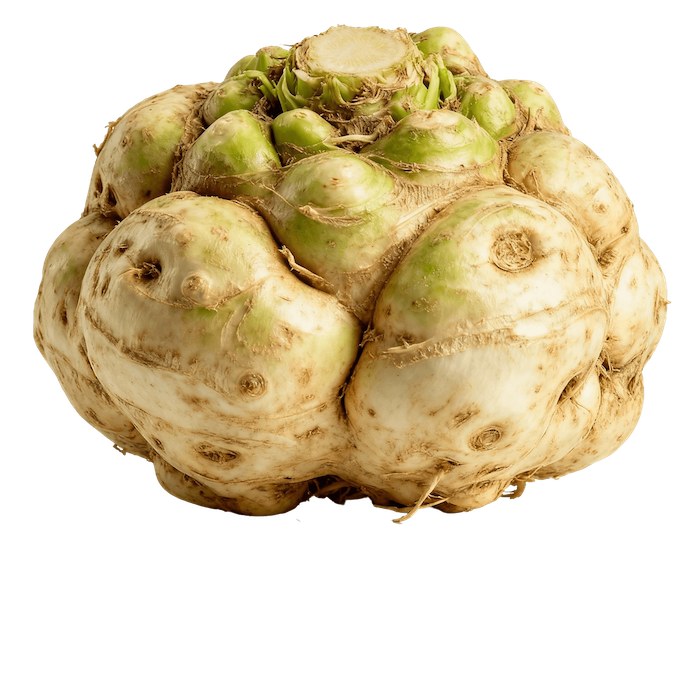
Vegetable Detail

Celeriac (Celery Root)

Celeriac (Celery Root)

FamilyApiaceae
Importance
Celeriac is the swollen root base of Apium graveolens var. rapaceum, valued for its celery-like aroma, firm white flesh, fiber, potassium, phosphorus, vitamin K, vitamin C, vitamin B6, magnesium, and aromatic Apiaceae-family phytochemicals. Per 100 g, raw celeriac provides about 42 calories, 9.2 g carbohydrate, 1.8 g fiber, 1.5 g protein, and very little fat. Its flavor is earthy, nutty, and celery-like, making it useful in soups, roasted vegetable dishes, mashed root preparations, slaws, stews, and grain bowls. Its carbohydrate occurs within a root vegetable matrix of water, fiber, minerals, organic acids, and aromatic compounds.

Celeriac supports everyday nourishment through fiber, potassium, vitamin K, vitamin C, phosphorus, and vitamin B6. Fiber supports digestive movement, stool bulk, and microbial fermentation. Potassium supports fluid balance, nerve signaling, and muscle contraction. Vitamin K supports normal blood-clotting protein activation and bone-related protein function. Vitamin C contributes to collagen formation, antioxidant recycling, immune barrier function, and connective tissue maintenance. Phosphorus supports bone mineral structure and ATP-related energy metabolism. Vitamin B6 supports amino acid metabolism and neurotransmitter-related enzyme systems.

For cancer and ailment-support nutrition, celeriac is relevant because Apium vegetables contain phenolic acids, flavonoids, apigenin-related compounds, luteolin-related compounds, coumarins, phthalide-related aroma compounds, fiber, vitamin C, potassium, and mineral cofactors. These compounds connect to Nrf2-related antioxidant response, NF-kB inflammatory signaling balance, AMPK-linked metabolic regulation, insulin-related carbohydrate handling, endothelial function, phase II detoxification enzyme signaling, apoptosis-related cell signaling, and gut fermentation pathways supported by fiber. Celeriac does not act as a standalone disease solution, but the whole root contributes digestive fiber, minerals, vitamin C, aromatic compounds, and Apiaceae-family phytochemicals tied to cellular repair, inflammatory signaling balance, vascular support, digestive function, and normal metabolic regulation.

Celeriac pairs well with carrots, onions, garlic, potatoes, mushrooms, lentils, beans, chickpeas, cabbage, kale, apples, lemon, parsley, dill, thyme, rosemary, brown rice, barley, quinoa, walnuts, and pumpkin seeds. Its strongest nutritional identity is the combination of celery-root flavor, fiber, potassium, vitamin K, vitamin C, phosphorus, apigenin-related compounds, luteolin-related compounds, and Apium-family phytochemicals connected to antioxidant, digestive, vascular, metabolic, inflammatory, and cellular defense pathways.

Region FoundCeleriac Apium graveolens var. rapaceum is cultivated mainly in Europe, North America, and temperate vegetable-growing regions. It is common in France, Germany, the Netherlands, the United Kingdom, Scandinavia, eastern Europe, the United States, and Canada. It grows best in cool seasons with fertile moisture-retentive soil, steady irrigation, and a long growing period.
Helps Fight These Cancers: Colorectal, Stomach, Liver (Linked Via Fiber And Polyphenols)
Helps Fight These Ailments: Contains Phenolic Acids And Apigenin Derivatives That Exhibit Anti Inflammatory And Detox Supportive Effects.
Linked Hormones:

All values per 100g
Nutrition Facts
Calories (kcal)42
Protein (g)1.5
Carbohydrates (g)9.2
Fiber (g)1.8
Sugars (g)1.6
Total Fat (g)0.3
Saturated Fat (g)0
Vitamins
Vitamin A (µg RAE)3
Vitamin C (mg)8
Vitamin D (µg)0
Vitamin E (mg)0.29
Vitamin K (µg)41
Vitamin B1 / Thiamin (mg)0.03
Vitamin B2 / Riboflavin (mg)0.06
Vitamin B3 / Niacin (mg)0.7
Vitamin B5 / Pantothenic Acid (mg)0.4
Vitamin B6 (mg)0.165
Vitamin B7 / Biotin (µg)0
Folate B9 (µg)8
Vitamin B12 (µg)0
Vitamin Detail Pages
Minerals
Calcium (mg)43
Iron (mg)0.7
Magnesium (mg)20
Phosphorus (mg)115
Potassium (mg)300
Sodium (mg)100
Zinc (mg)0.35
Copper (mg)0.066
Manganese (mg)0.158
Selenium (µg)0.7
Iodine (µg)0
Mineral Detail Pages
Amino Acids
Alanine (mg)68 mg
Arginine (mg)74 mg
Asparagine (mg)0 mg
Aspartic Acid (mg)153 mg
Cysteine (mg)14 mg
Glutamic Acid (mg)275 mg
Glutamine (mg)0 mg
Glycine (mg)51 mg
Histidine (mg)24 mg
Isoleucine (mg)41 mg
Leucine (mg)69 mg
Lysine (mg)71 mg
Methionine (mg)14 mg
Phenylalanine (mg)41 mg
Proline (mg)36 mg
Serine (mg)50 mg
Threonine (mg)44 mg
Tryptophan (mg)14 mg
Tyrosine (mg)32 mg
Valine (mg)52 mg
Amino Acid Detail Pages
Phytochemicals
Phenolic acids, caffeic acid derivatives, ferulic acid derivatives, flavonoids, apigenin-related compounds, luteolin-related compounds, coumarins, phthalide-related aroma compounds, volatile terpenes, fiber, vitamin K, vitamin C, vitamin B6, potassium, phosphorus, magnesium, manganese, and Apium graveolens var. rapaceum bioactive compounds. Research references: Kooti W, Daraei N. A Review of the Antioxidant Activity of Celery Apium graveolens L. Journal of Evidence-Based Complementary and Alternative Medicine. 2017. Chon SU, Heo BG, Park YS, Kim DK, Gorinstein S. Total phenolics level, antioxidant activities and cytotoxicity of young sprouts of some traditional Korean salad plants. Plant Foods for Human Nutrition. 2009. Yao Y, Sang W, Zhou M, Ren G. Phenolic composition and antioxidant activities of 11 celery cultivars. Journal of Food Science. 2010.
Research & Notes
Research Notes:
USDA FoodData Central via MyFoodData per 100 g raw celeriac. Nutrient data from FDC SR database; amino acids scaled to 100 g using MyFoodData reference for celery family vegetables. Biotin, iodine, asparagine, and glutamine not reported → NULL. High-fiber intake from celeriac correlated with lower gastrointestinal cancer risk.
Notes:
Raw celeriac root baseline.
Created: 2025-10-23 17:25:17
Last Updated: 2026-06-04 08:13:13