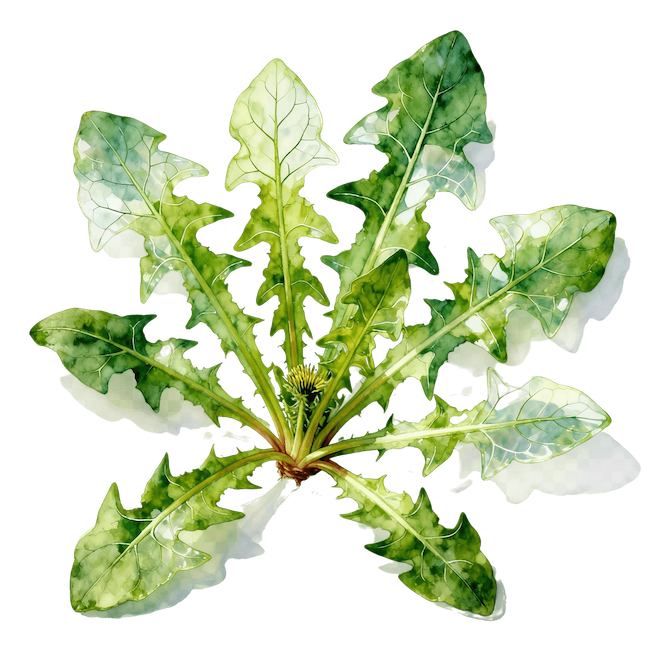
Vegetable Detail

Dandelion Greens

Dandelion Greens

FamilyAsteraceae
Importance
Dandelion greens are the edible leaves of Taraxacum officinale, valued for their bitter flavor, deep green color, vitamin K, vitamin A carotenoid activity, vitamin C, folate, calcium, potassium, magnesium, iron, fiber, and Asteraceae-family phytochemicals. Per 100 g, raw dandelion greens provide about 45 calories, 9.2 g carbohydrate, 3.5 g fiber, 2.7 g protein, and very little fat. Their bitter taste comes from sesquiterpene lactones and phenolic compounds, while their green color reflects chlorophyll and carotenoid pigments. They can be eaten raw in small amounts, steamed, added to soups, folded into bean dishes, or mixed with milder greens.

Dandelion greens support everyday nourishment through vitamin K, carotenoids, vitamin C, folate, calcium, potassium, magnesium, and fiber. Vitamin K supports normal blood-clotting protein activation and bone-related protein function. Carotenoids contribute vitamin A activity and antioxidant pigment chemistry. Vitamin C contributes to collagen formation, antioxidant recycling, immune barrier function, and connective tissue maintenance. Folate participates in one-carbon metabolism, DNA synthesis, and normal cell division. Calcium and magnesium support bone mineral structure, muscle function, nerve signaling, and enzyme activity. Fiber supports digestive movement and microbial fermentation.

For cancer and ailment-support nutrition, dandelion greens are relevant because Taraxacum leaves contain chicoric acid, chlorogenic acid, caffeic acid derivatives, luteolin derivatives, quercetin derivatives, sesquiterpene lactones, triterpenes, inulin-type compounds, chlorophylls, beta-carotene, lutein, zeaxanthin, vitamin C, folate, minerals, and fiber. These compounds connect to Nrf2-related antioxidant response, NF-kB inflammatory signaling balance, AMPK-linked metabolic regulation, insulin-related carbohydrate handling, endothelial function, phase II detoxification enzyme signaling, apoptosis-related cell signaling, bile-related digestive signaling, and gut fermentation pathways supported by fiber. Dandelion greens do not act as a standalone disease solution, but the whole leafy vegetable contributes bitter phytochemicals, antioxidant pigments, digestive fiber, minerals, folate, and polyphenols tied to cellular repair, inflammatory signaling balance, vascular support, digestive function, and normal metabolic regulation.

Dandelion greens pair well with beans, lentils, chickpeas, mushrooms, onions, garlic, tomatoes, potatoes, brown rice, quinoa, barley, citrus, apples, parsley, dill, basil, walnuts, almonds, and pumpkin seeds. Their strongest nutritional identity is the combination of bitter leafy greens, vitamin K, carotenoids, calcium, potassium, chlorophyll, chicoric acid, chlorogenic acid, sesquiterpene lactones, and Taraxacum-family phytochemicals connected to antioxidant, digestive, vascular, metabolic, inflammatory, and cellular defense pathways.

Region FoundDandelion greens Taraxacum officinale grow widely across Europe, Asia, North America, South America, Australia, and many temperate regions. They are cultivated as bitter greens and also grow wild in meadows, gardens, lawns, field edges, and disturbed soils. Harvest quality is best from young tender leaves grown in clean soils before strong bitterness develops.
Helps Fight These Cancers: Liver, Colorectal, Breast, Stomach
Helps Fight These Ailments: Contains Sesquiterpene Lactones And Polyphenols That Induce Detoxification Enzymes And Reduce Oxidative Stress, Supports Bile Flow And Digestion.

All values per 100g
Nutrition Facts
Calories (kcal)45
Protein (g)2.7
Carbohydrates (g)9.2
Fiber (g)3.5
Sugars (g)0.71
Total Fat (g)0.7
Saturated Fat (g)0
Vitamins
Vitamin A (µg RAE)508
Vitamin C (mg)35
Vitamin D (µg)0
Vitamin E (mg)3.4
Vitamin K (µg)778
Vitamin B1 / Thiamin (mg)0.19
Vitamin B2 / Riboflavin (mg)0.26
Vitamin B3 / Niacin (mg)0.806
Vitamin B5 / Pantothenic Acid (mg)0.084
Vitamin B6 (mg)0.251
Vitamin B7 / Biotin (µg)0
Folate B9 (µg)27
Vitamin B12 (µg)0
Vitamin Detail Pages
Minerals
Calcium (mg)187
Iron (mg)3.1
Magnesium (mg)36
Phosphorus (mg)66
Potassium (mg)397
Sodium (mg)76
Zinc (mg)0.41
Copper (mg)0.15
Manganese (mg)0.342
Selenium (µg)0.8
Iodine (µg)0
Mineral Detail Pages
Amino Acids
Alanine (mg)140 mg
Arginine (mg)129 mg
Asparagine (mg)0 mg
Aspartic Acid (mg)270 mg
Cysteine (mg)35 mg
Glutamic Acid (mg)300 mg
Glutamine (mg)0 mg
Glycine (mg)120 mg
Histidine (mg)50 mg
Isoleucine (mg)94 mg
Leucine (mg)170 mg
Lysine (mg)140 mg
Methionine (mg)30 mg
Phenylalanine (mg)110 mg
Proline (mg)100 mg
Serine (mg)110 mg
Threonine (mg)90 mg
Tryptophan (mg)30 mg
Tyrosine (mg)70 mg
Valine (mg)130 mg
Amino Acid Detail Pages
Phytochemicals
Chicoric acid, chlorogenic acid, caffeic acid derivatives, luteolin derivatives, quercetin derivatives, sesquiterpene lactones, taraxasterol-related triterpenes, inulin-type compounds, chlorophyll a, chlorophyll b, beta-carotene, lutein, zeaxanthin, vitamin K, vitamin C, folate, calcium, potassium, magnesium, iron, fiber, and Taraxacum officinale bioactive compounds. Research references: Schütz K, Carle R, Schieber A. Taraxacum—a review on its phytochemical and pharmacological profile. Journal of Ethnopharmacology. 2006. González-Castejón M, Visioli F, Rodriguez-Casado A. Diverse biological activities of dandelion. Nutrition Reviews. 2012. Jedrejek D, Kontek B, Lis B, Stochmal A, Olas B. Evaluation of antioxidant activity of phenolic fractions from dandelion Taraxacum officinale roots and leaves. Molecules. 2017.
Research & Notes
Research Notes:
USDA FoodData Central and MyFoodData per 100 g raw dandelion greens. Nutrient values from FDC SR; amino acids scaled to 100 g using leafy green amino profiles. Biotin, iodine, asparagine, and glutamine not reported → NULL. Chlorogenic acid and luteolin shown to suppress pro-inflammatory signaling and support detoxification in the liver.
Notes:
Raw dandelion leaves baseline.
Created: 2025-10-23 17:26:05
Last Updated: 2026-06-04 08:13:13