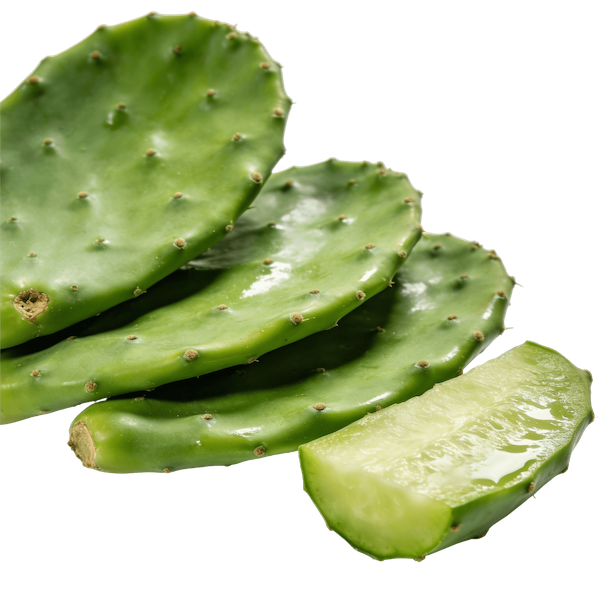
Vegetable Detail

Nopal Cactus Pads (Prickly Pear Pads)

Nopal Cactus Pads (Prickly Pear Pads)

FamilyCactaceae
Importance
Nopal cactus pads are the young edible pads of Opuntia ficus-indica and related Opuntia species, valued for their mild tangy flavor, crisp-tender texture, hydration, soluble fiber, mucilage, vitamin C, magnesium, potassium, calcium, manganese, carotenoids, betalains, flavonoids, and cactus-family polyphenols. Per 100 g, raw nopal pads provide about 16 calories, 3.3 g carbohydrate, 2.2 g fiber, 1.3 g protein, and very little fat. Their distinctive texture comes from mucilage polysaccharides, a gel-forming fiber that helps define nopal as a hydrating, mineral-rich, low-calorie vegetable.

Nopal cactus pads support everyday nourishment through water, fiber, vitamin C, magnesium, potassium, calcium, and antioxidant pigments. Fiber supports digestive movement, stool bulk, microbial fermentation, and short-chain fatty acid production. Vitamin C contributes to collagen formation, antioxidant recycling, immune barrier function, and connective tissue maintenance. Magnesium participates in ATP-related energy metabolism and normal muscle function. Potassium supports fluid balance, nerve signaling, and muscle contraction. Calcium supports bone mineral structure and cellular signaling. Mucilage helps slow digestive transit and supports a gentle, fiber-rich food matrix.

For cancer and ailment-support nutrition, nopal cactus pads are relevant because Opuntia pads contain mucilage polysaccharides, pectin, soluble fiber, insoluble fiber, betalains, betacyanins, betaxanthins, quercetin derivatives, kaempferol derivatives, isorhamnetin derivatives, phenolic acids, vitamin C, magnesium, calcium, and potassium. These compounds connect to gut fermentation pathways, short-chain fatty acid production, AMPK-linked metabolic regulation, insulin-related carbohydrate handling, GLP-1-related incretin signaling, endothelial function, Nrf2-related antioxidant response, NF-kB inflammatory signaling balance, phase II detoxification enzyme signaling, apoptosis-related cell signaling, and cellular repair pathways. Nopal pads contribute hydrating cactus fiber, mucilage, minerals, vitamin C, betalain pigments, and Opuntia-family phytochemicals tied to digestive function, metabolic regulation, vascular support, inflammatory signaling balance, antioxidant defense, cellular repair, and normal glucose-handling pathways.

Nopal cactus pads pair well with tomatoes, onions, garlic, peppers, corn, beans, lentils, chickpeas, mushrooms, cabbage, brown rice, quinoa, cilantro, parsley, lime, avocado, pumpkin seeds, sesame seeds, walnuts, and almonds. Their strongest nutritional identity is the combination of low-calorie cactus pads, mucilage-rich fiber, hydration, magnesium, potassium, calcium, vitamin C, betalains, flavonoids, and Opuntia-family phytochemicals connected to digestive, metabolic, vascular, antioxidant, inflammatory, fermentation, and cellular support pathways.

Region FoundNopal cactus pads come from Opuntia species native to Mexico and the Americas and are now cultivated in Mexico, the southwestern United States, Central America, South America, the Mediterranean region, North Africa, the Middle East, India, and other arid or semi-arid regions. They grow best in full sun, dry climates, well-drained soils, and warm conditions with drought tolerance once established.
Helps Fight These Cancers: Colon, Stomach, Liver
Helps Fight These Ailments: High In Soluble Fiber And Polyphenols, Shown To Lower Postprandial Glucose And Oxidative Stress, Prebiotic Mucilage Supports Gut Microbiota Balance.

All values per 100g
Nutrition Facts
Calories (kcal)16
Protein (g)1.33
Carbohydrates (g)3.33
Fiber (g)2.2
Sugars (g)1.26
Total Fat (g)0.08
Saturated Fat (g)0
Vitamins
Vitamin A (µg RAE)5
Vitamin C (mg)9.3
Vitamin D (µg)0
Vitamin E (mg)0.02
Vitamin K (µg)5.3
Vitamin B1 / Thiamin (mg)0.012
Vitamin B2 / Riboflavin (mg)0.061
Vitamin B3 / Niacin (mg)0.41
Vitamin B5 / Pantothenic Acid (mg)0.17
Vitamin B6 (mg)0.06
Vitamin B7 / Biotin (µg)0
Folate B9 (µg)6
Vitamin B12 (µg)0
Vitamin Detail Pages
Minerals
Calcium (mg)164
Iron (mg)0.59
Magnesium (mg)52
Phosphorus (mg)32
Potassium (mg)257
Sodium (mg)21
Zinc (mg)0.12
Copper (mg)0.05
Manganese (mg)0.07
Selenium (µg)0.7
Iodine (µg)0
Mineral Detail Pages
Amino Acids
Alanine (mg)50 mg
Arginine (mg)45 mg
Asparagine (mg)0 mg
Aspartic Acid (mg)105 mg
Cysteine (mg)10 mg
Glutamic Acid (mg)150 mg
Glutamine (mg)0 mg
Glycine (mg)40 mg
Histidine (mg)20 mg
Isoleucine (mg)35 mg
Leucine (mg)60 mg
Lysine (mg)50 mg
Methionine (mg)12 mg
Phenylalanine (mg)38 mg
Proline (mg)35 mg
Serine (mg)45 mg
Threonine (mg)38 mg
Tryptophan (mg)10 mg
Tyrosine (mg)25 mg
Valine (mg)50 mg
Amino Acid Detail Pages
Phytochemicals
Mucilage polysaccharides, pectin, soluble fiber, insoluble fiber, betalains, betacyanins, betaxanthins, quercetin derivatives, kaempferol derivatives, isorhamnetin derivatives, phenolic acids, ferulic acid derivatives, caffeic acid derivatives, p-coumaric acid derivatives, carotenoid traces, vitamin C, magnesium, calcium, potassium, manganese, and Opuntia ficus-indica bioactive compounds. Research references: Stintzing FC, Carle R. Cactus stems Opuntia spp.: A review on their chemistry, technology, and uses. Molecular Nutrition & Food Research. 2005. Galati EM, Mondello MR, Giuffrida D, Dugo G, Miceli N, Pergolizzi S, Taviano MF. Chemical characterization and biological effects of Sicilian Opuntia ficus-indica cladodes. Journal of Agricultural and Food Chemistry. 2003. El-Mostafa K, El Kharrassi Y, Badreddine A, Andreoletti P, Vamecq J, El Kebbaj MS, Latruffe N, Lizard G, Nasser B, Cherkaoui-Malki M. Nopal cactus Opuntia ficus-indica as a source of bioactive compounds for nutrition, health and disease. Molecules. 2014.
Research & Notes
Research Notes:
USDA FDC and MyFoodData per 100 g raw nopales. Amino acid data derived from FDC composite vegetable dataset. Biotin, iodine, asparagine, and glutamine not reported → NULL.
Notes:
Raw 100 g baseline; cleaned, de-spined pads.
Created: 2025-10-23 18:01:10
Last Updated: 2026-06-04 08:13:13