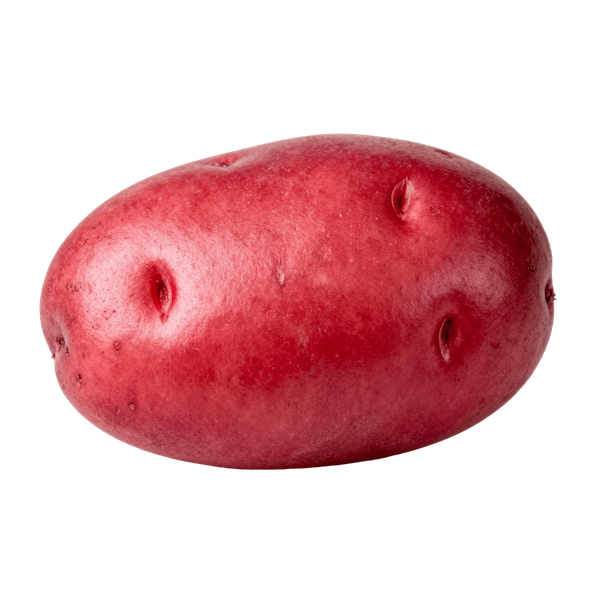
Vegetable Detail

Potato (Red, flesh & skin, raw)

Potato (Red, flesh & skin, raw)

FamilySolanaceae
Importance
Red potato is a red-skinned tuber of Solanum tuberosum, valued for its thin colorful skin, creamy flesh, potassium, vitamin C, vitamin B6, fiber, manganese, magnesium, phosphorus, copper, and potato-family phytochemicals. Per 100 g, raw red potato with skin provides about 70 to 77 calories, roughly 15.9 to 17.5 g carbohydrate, about 1.8 to 2.2 g fiber, about 2.0 g protein, and very little fat. Its carbohydrate occurs within a whole tuber matrix that includes starch, resistant starch potential after cooling, fiber, minerals, amino acids, organic acids, and phenolic compounds. The red skin is especially important because colored potato skins concentrate anthocyanins and phenolic acids.

Red potato supports everyday nourishment through complex carbohydrate, potassium, vitamin C, vitamin B6, fiber, manganese, and magnesium. Starch provides usable energy, while fiber supports digestive movement, stool bulk, microbial fermentation, and short-chain fatty acid production. Potassium supports fluid balance, nerve signaling, and muscle contraction. Vitamin C contributes to collagen formation, antioxidant recycling, immune barrier function, and connective tissue maintenance. Vitamin B6 supports amino acid metabolism and neurotransmitter-related enzyme systems. Magnesium and phosphorus participate in ATP-related energy metabolism, while manganese supports antioxidant enzyme systems and connective tissue formation.

For cancer and ailment-support nutrition, red potato is relevant because Solanum tuberosum contains chlorogenic acid, caffeic acid derivatives, ferulic acid derivatives, anthocyanins in red skin, flavonoids, carotenoid traces, resistant starch potential, fiber, vitamin C, potassium, magnesium, and manganese. These compounds connect to gut fermentation pathways, short-chain fatty acid production, AMPK-linked metabolic regulation, insulin-related carbohydrate handling, endothelial function, Nrf2-related antioxidant response, NF-kB inflammatory signaling balance, phase II detoxification enzyme signaling, apoptosis-related cell signaling, and cellular repair pathways. Red potato contributes steady tuber energy, digestive fiber, potassium, vitamin C, red-skin anthocyanins, phenolic acids, and mineral cofactors tied to digestive function, metabolic regulation, vascular support, inflammatory signaling balance, antioxidant defense, cellular repair, and normal energy metabolism.

Red potato pairs well with onions, garlic, leeks, mushrooms, cabbage, kale, lentils, beans, chickpeas, carrots, parsley, dill, rosemary, thyme, lemon, brown rice, quinoa, barley, walnuts, almonds, and pumpkin seeds. Its strongest nutritional identity is the combination of red skin, creamy starch, potassium, vitamin C, vitamin B6, fiber, chlorogenic acid, anthocyanins, and Solanum-family phytochemicals connected to digestive, metabolic, vascular, antioxidant, inflammatory, fermentation, and cellular support pathways.

Region FoundRed potato Solanum tuberosum cultivars are grown worldwide in temperate and subtropical highland regions. Potato originated in the Andean region of South America and is now cultivated across North America, Europe, China, India, South America, Australia, and many other regions. Red potatoes grow best in fertile well-drained soils, cool growing temperatures, full sun, steady moisture, and careful storage away from light.
Glycemic Index78.0
Glycemic Load12.25
Helps Fight These Cancers: Colorectal (Fiber/Resistant Starch Association)
Helps Fight These Ailments: Phenolic Acids And Resistant Starch Support Antioxidant Defenses And A Healthy Gut Microbiome.

All values per 100g
Nutrition Facts
Calories (kcal)70
Protein (g)1.89
Carbohydrates (g)15.9
Fiber (g)2.2
Sugars (g)1.13
Total Fat (g)0.14
Saturated Fat (g)0
Vitamins
Vitamin A (µg RAE)0
Vitamin C (mg)11.4
Vitamin D (µg)0
Vitamin E (mg)0.01
Vitamin K (µg)2
Vitamin B1 / Thiamin (mg)0.081
Vitamin B2 / Riboflavin (mg)0.016
Vitamin B3 / Niacin (mg)1.44
Vitamin B5 / Pantothenic Acid (mg)0.296
Vitamin B6 (mg)0.299
Vitamin B7 / Biotin (µg)0
Folate B9 (µg)16
Vitamin B12 (µg)0
Vitamin Detail Pages
Minerals
Calcium (mg)10
Iron (mg)0.73
Magnesium (mg)22
Phosphorus (mg)57
Potassium (mg)429
Sodium (mg)7
Zinc (mg)0.34
Copper (mg)0.11
Manganese (mg)0.152
Selenium (µg)0.4
Iodine (µg)0
Mineral Detail Pages
Amino Acids
Alanine (mg)60 mg
Arginine (mg)100 mg
Asparagine (mg)0 mg
Aspartic Acid (mg)480 mg
Cysteine (mg)22 mg
Glutamic Acid (mg)330 mg
Glutamine (mg)0 mg
Glycine (mg)55 mg
Histidine (mg)30 mg
Isoleucine (mg)60 mg
Leucine (mg)90 mg
Lysine (mg)95 mg
Methionine (mg)25 mg
Phenylalanine (mg)70 mg
Proline (mg)60 mg
Serine (mg)75 mg
Threonine (mg)60 mg
Tryptophan (mg)18 mg
Tyrosine (mg)50 mg
Valine (mg)85 mg
Amino Acid Detail Pages
Phytochemicals
Chlorogenic acid, caffeic acid derivatives, ferulic acid derivatives, p-coumaric acid derivatives, anthocyanins in red skin, pelargonidin-related pigments, flavonoids, carotenoid traces, resistant starch potential after cooking and cooling, soluble fiber, insoluble fiber, vitamin C, vitamin B6, potassium, manganese, magnesium, phosphorus, copper, and Solanum tuberosum bioactive compounds. Research references: Navarre DA, Shakya R, Holden J, Kumar S. The effect of different cooking methods on phenolics and vitamin C in developmentally young potato tubers. American Journal of Potato Research. 2010. Andre CM, Ghislain M, Bertin P, Oufir M, Herrera MR, Hoffmann L, Hausman JF, Larondelle Y, Evers D. Andean potato cultivars Solanum tuberosum L. as a source of antioxidant and mineral micronutrients. Journal of Agricultural and Food Chemistry. 2007. Ezekiel R, Singh N, Sharma S, Kaur A. Beneficial phytochemicals in potato: a review. Food Research International. 2013.
Research & Notes
Research Notes:
USDA FDC per 100 g raw red potato (flesh & skin). Biotin, iodine, asparagine, and glutamine not reported → NULL.
Notes:
Raw 100 g baseline; values reflect red potato with skin.
Created: 2025-10-23 18:23:29
Last Updated: 2026-06-04 08:13:13