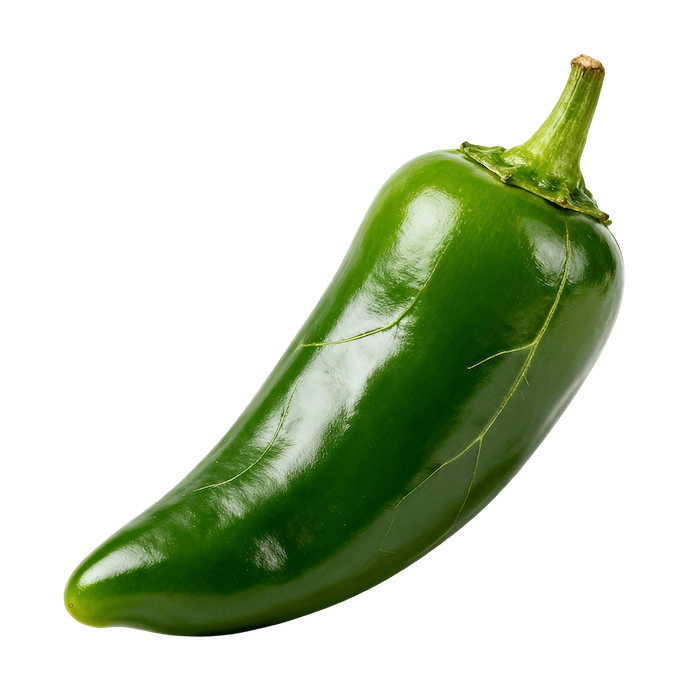
Vegetable Detail

Chili Pepper (Jalapeño)

Chili Pepper (Jalapeño)

FamilySolanaceae
Importance
Jalapeño pepper is the green or red chili fruit of Capsicum annuum, valued for its bright heat, crisp flesh, vitamin C, vitamin B6, vitamin K, folate, potassium, fiber, carotenoids, flavonoids, phenolic acids, and capsaicinoid compounds. Per 100 g, raw jalapeño provides about 29 calories, 6.5 g carbohydrate, 2.8 g fiber, 0.9 g protein, and very little fat. Its heat comes mainly from capsaicin and related capsaicinoids concentrated around the inner membranes and seeds. Green jalapeños have a grassy, sharp flavor, while red ripe jalapeños develop more sweetness and deeper carotenoid pigment.

Jalapeño supports everyday nourishment through vitamin C, fiber, potassium, vitamin B6, and pepper-family phytochemicals. Vitamin C contributes to collagen formation, antioxidant recycling, immune barrier function, and connective tissue maintenance. Fiber supports digestive movement, stool bulk, and microbial fermentation. Potassium supports fluid balance, nerve signaling, and muscle contraction. Vitamin B6 supports amino acid metabolism and neurotransmitter-related enzyme systems. Carotenoids and flavonoids contribute antioxidant pigment chemistry and cellular protection.

For cancer and ailment-support nutrition, jalapeño is relevant because Capsicum peppers contain capsaicin, dihydrocapsaicin, carotenoids, beta-carotene, lutein, zeaxanthin, chlorophyll in green fruit, quercetin derivatives, luteolin derivatives, apigenin derivatives, phenolic acids, vitamin C, vitamin B6, potassium, and fiber. These compounds connect to TRPV1 signaling, Nrf2-related antioxidant response, NF-kB inflammatory signaling balance, AMPK-linked metabolic regulation, insulin-related carbohydrate handling, endothelial function, phase II detoxification enzyme signaling, apoptosis-related cell signaling, and gut fermentation pathways supported by fiber. Jalapeño does not act as a standalone disease solution, but the whole pepper contributes antioxidant nutrients, digestive fiber, minerals, pungent capsaicinoids, and Capsicum-family phytochemicals tied to cellular repair, inflammatory signaling balance, vascular support, digestive function, metabolic regulation, and normal antioxidant defense.

Jalapeño pairs well with beans, lentils, chickpeas, tomatoes, onions, garlic, mushrooms, corn, potatoes, cabbage, leafy greens, brown rice, quinoa, cilantro, parsley, lime, avocado, pumpkin seeds, and walnuts. Its strongest nutritional identity is the combination of mild-to-moderate chili heat, vitamin C, fiber, potassium, capsaicin, carotenoids, flavonoids, and Capsicum-family phytochemicals connected to antioxidant, digestive, vascular, metabolic, inflammatory, TRPV1, and cellular defense pathways.

Region FoundJalapeño pepper Capsicum annuum originated from domesticated Capsicum crops in Mexico and Central America and is now cultivated widely in warm-season vegetable systems. Major growing regions include Mexico, the United States, Central America, South America, Spain, China, India, and greenhouse systems worldwide. It grows best in full sun, fertile well-drained soils, warm temperatures, and regular moisture.
Helps Fight These Cancers: Prostate, Colon, Gastric
Helps Fight These Ailments: Capsaicin Has Been Studied For Anti Inflammatory, Thermogenic, And Potential Anticancer Effects, Promotes Vasodilation And Apoptosis In Tumor Cells.
Linked Hormones:

All values per 100g
Nutrition Facts
Calories (kcal)29
Protein (g)0.91
Carbohydrates (g)6.5
Fiber (g)2.8
Sugars (g)4.1
Total Fat (g)0.4
Saturated Fat (g)0
Vitamins
Vitamin A (µg RAE)54
Vitamin C (mg)118.6
Vitamin D (µg)0
Vitamin E (mg)0.69
Vitamin K (µg)18.5
Vitamin B1 / Thiamin (mg)0.06
Vitamin B2 / Riboflavin (mg)0.09
Vitamin B3 / Niacin (mg)1.07
Vitamin B5 / Pantothenic Acid (mg)0.3
Vitamin B6 (mg)0.419
Vitamin B7 / Biotin (µg)0
Folate B9 (µg)27
Vitamin B12 (µg)0
Vitamin Detail Pages
Minerals
Calcium (mg)12
Iron (mg)0.25
Magnesium (mg)25
Phosphorus (mg)26
Potassium (mg)248
Sodium (mg)3
Zinc (mg)0.17
Copper (mg)0.017
Manganese (mg)0.108
Selenium (µg)0.4
Iodine (µg)0
Mineral Detail Pages
Amino Acids
Alanine (mg)38 mg
Arginine (mg)50 mg
Asparagine (mg)0 mg
Aspartic Acid (mg)120 mg
Cysteine (mg)14 mg
Glutamic Acid (mg)180 mg
Glutamine (mg)0 mg
Glycine (mg)35 mg
Histidine (mg)18 mg
Isoleucine (mg)32 mg
Leucine (mg)50 mg
Lysine (mg)44 mg
Methionine (mg)10 mg
Phenylalanine (mg)41 mg
Proline (mg)34 mg
Serine (mg)47 mg
Threonine (mg)34 mg
Tryptophan (mg)10 mg
Tyrosine (mg)26 mg
Valine (mg)41 mg
Amino Acid Detail Pages
Phytochemicals
Capsaicin, dihydrocapsaicin, capsaicinoids, beta-carotene, lutein, zeaxanthin, chlorophyll a, chlorophyll b, quercetin derivatives, luteolin derivatives, apigenin derivatives, phenolic acids, caffeic acid derivatives, ferulic acid derivatives, flavonoids, vitamin C, vitamin B6, vitamin K, folate, potassium, manganese, fiber, and Capsicum annuum bioactive compounds. Research references: Luo XJ, Peng J, Li YJ. Recent advances in the study on capsaicinoids and capsinoids. European Journal of Pharmacology. 2011. Howard LR, Talcott ST, Brenes CH, Villalon B. Changes in phytochemical and antioxidant activity of selected pepper cultivars as influenced by maturity. Journal of Agricultural and Food Chemistry. 2000. Marín A, Ferreres F, Tomás-Barberán FA, Gil MI. Characterization and quantitation of antioxidant constituents of sweet pepper Capsicum annuum L. Journal of Agricultural and Food Chemistry. 2004.
Research & Notes
Research Notes:
USDA FDC per 100 g raw jalapeño peppers. Biotin, iodine, asparagine, and glutamine not reported → NULL.
Notes:
Raw 100 g baseline; fresh jalapeño pepper values.
Created: 2025-10-23 18:41:17
Last Updated: 2026-06-04 08:13:13