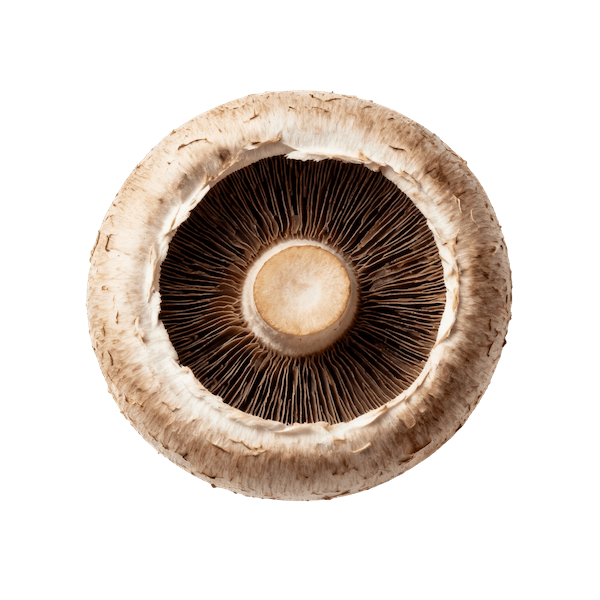
Vegetable Detail

Portobello Mushroom

Portobello Mushroom

FamilyAgaricaceae
Importance
Portobello mushroom is the fully mature brown form of Agaricus bisporus, valued for its large cap, dense texture, savory umami flavor, low calorie density, protein, fiber, potassium, phosphorus, copper, selenium, riboflavin, niacin, pantothenic acid, and mushroom-specific compounds. Per 100 g, raw portobello mushrooms provide about 22 calories, 3.9 g carbohydrate, 1.3 g fiber, 2.1 g protein, and very little fat. Their nutrition differs from plant vegetables because mushrooms are fungi, with chitin-rich cell walls, beta-glucan-type fibers, amino acids, ergosterol, minerals, B vitamins, and antioxidant-active metabolites.

Portobello mushrooms support everyday nourishment through B vitamins, minerals, amino acids, and fungal fiber. Riboflavin, niacin, and pantothenic acid support energy metabolism through coenzyme systems. Copper supports iron handling, connective tissue enzyme systems, and redox balance. Selenium supports selenoprotein activity and antioxidant enzyme systems. Potassium supports fluid balance, nerve signaling, and muscle contraction. Phosphorus supports ATP-related energy metabolism and bone mineral structure. Chitin and beta-glucan-type polysaccharides support digestive bulk and microbial fermentation.

For cancer and ailment-support nutrition, portobello mushrooms are relevant because Agaricus bisporus contains ergothioneine, glutathione, beta-glucan-type polysaccharides, chitin, ergosterol, phenolic compounds, lectin-related proteins, selenium, copper, riboflavin, niacin, and potassium. These compounds connect to Nrf2-related antioxidant response, glutathione-related redox balance, NF-kB inflammatory signaling balance, AMPK-linked metabolic regulation, insulin-related carbohydrate handling, immune signaling, endothelial function, phase II detoxification enzyme signaling, apoptosis-related cell signaling, gut fermentation pathways, and cellular repair pathways. Portobello mushrooms contribute fungal antioxidant metabolites, digestive fiber, minerals, B vitamins, amino acids, polysaccharides, and Agaricus-family compounds tied to inflammatory signaling balance, immune communication, vascular support, digestive function, antioxidant defense, cellular repair, and normal metabolic regulation.

Portobello mushrooms pair well with onions, garlic, leeks, tomatoes, lentils, beans, chickpeas, cabbage, kale, potatoes, brown rice, barley, quinoa, parsley, thyme, rosemary, walnuts, almonds, and pumpkin seeds. Their strongest nutritional identity is the combination of large mature mushroom caps, savory umami flavor, low calorie density, B vitamins, selenium, copper, ergothioneine, glutathione, beta-glucan-type fiber, ergosterol, and Agaricus-family bioactive compounds connected to digestive, immune, vascular, metabolic, antioxidant, inflammatory, and cellular support pathways.

Region FoundPortobello mushrooms Agaricus bisporus are cultivated worldwide in controlled mushroom-growing systems rather than field soil. Major production regions include the United States, Canada, the Netherlands, Poland, France, Ireland, China, India, and Australia. They are grown on composted agricultural substrates under controlled humidity, temperature, ventilation, and light conditions until the caps mature fully.
Helps Fight These Cancers: Prostate, Breast, Colorectal
Helps Fight These Ailments: Contains Beta Glucans And Ergothioneine With Antioxidant And Immune Enhancing Properties, Studied For Aromatase Inhibition And Psa Regulation Similar To Other Agaricus Species.
Linked Hormones:

All values per 100g
Nutrition Facts
Calories (kcal)22
Protein (g)2.11
Carbohydrates (g)3.87
Fiber (g)1.3
Sugars (g)2.5
Total Fat (g)0.35
Saturated Fat (g)0
Vitamins
Vitamin A (µg RAE)0
Vitamin C (mg)0
Vitamin D (µg)0.3
Vitamin E (mg)0.01
Vitamin K (µg)0
Vitamin B1 / Thiamin (mg)0.07
Vitamin B2 / Riboflavin (mg)0.38
Vitamin B3 / Niacin (mg)3.6
Vitamin B5 / Pantothenic Acid (mg)1.5
Vitamin B6 (mg)0.1
Vitamin B7 / Biotin (µg)0
Folate B9 (µg)16
Vitamin B12 (µg)0
Vitamin Detail Pages
Minerals
Calcium (mg)3
Iron (mg)0.5
Magnesium (mg)9
Phosphorus (mg)86
Potassium (mg)318
Sodium (mg)5
Zinc (mg)0.52
Copper (mg)0.318
Manganese (mg)0.047
Selenium (µg)9.3
Iodine (µg)0
Mineral Detail Pages
Amino Acids
Alanine (mg)168 mg
Arginine (mg)104 mg
Asparagine (mg)0 mg
Aspartic Acid (mg)195 mg
Cysteine (mg)20 mg
Glutamic Acid (mg)319 mg
Glutamine (mg)0 mg
Glycine (mg)92 mg
Histidine (mg)57 mg
Isoleucine (mg)82 mg
Leucine (mg)123 mg
Lysine (mg)127 mg
Methionine (mg)31 mg
Phenylalanine (mg)82 mg
Proline (mg)74 mg
Serine (mg)96 mg
Threonine (mg)95 mg
Tryptophan (mg)35 mg
Tyrosine (mg)44 mg
Valine (mg)103 mg
Amino Acid Detail Pages
Phytochemicals
Ergothioneine, glutathione, beta-glucan-type polysaccharides, chitin, ergosterol, phenolic compounds, lectin-related proteins, selenium, copper, potassium, phosphorus, riboflavin, niacin, pantothenic acid, biotin, fiber, and Agaricus bisporus bioactive compounds. Research references: Kalaras MD, Richie JP, Calcagnotto A, Beelman RB. Mushrooms: A rich source of the antioxidants ergothioneine and glutathione. Food Chemistry. 2017. Cheung PCK. Mini-review on edible mushrooms as source of dietary fiber: preparation and health benefits. Food Science and Human Wellness. 2013. Muszyńska B, Grzywacz-Kisielewska A, Kała K, Gdula-Argasińska J. Anti-inflammatory properties of edible mushrooms: A review. Food Chemistry. 2018.
Research & Notes
Research Notes:
USDA FDC per 100 g raw portobello mushrooms; amino acid profile scaled to 2.1 g protein/100 g. Biotin, iodine, asparagine, and glutamine not reported → NULL.
Notes:
Raw 100 g baseline; mature caps only.
Created: 2025-10-23 18:49:06
Last Updated: 2026-06-04 08:13:13