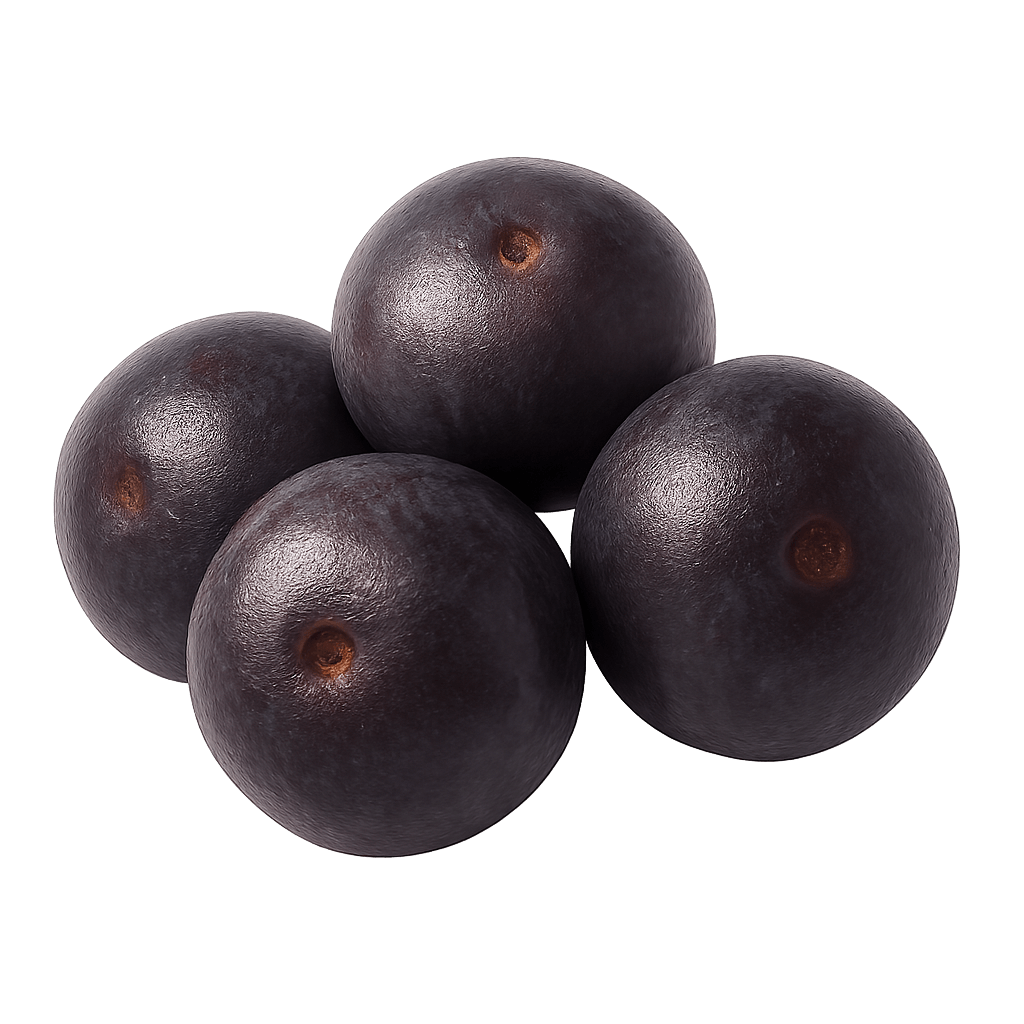
Açaí

Açaí

FamilyArecaceae
Importance
Açaí is a dark purple palm fruit from Euterpe oleracea, most often eaten as unsweetened frozen pulp. Its value comes from a rare fruit profile: modest carbohydrate, very low natural sugar when unsweetened, meaningful fiber, naturally occurring fats, minerals, and a dense group of purple polyphenols. The pulp is different from sweetened bowls or sorbets because those products can add sugar and sharply change the food’s glycemic effect. Plain açaí pulp is best understood as a concentrated whole-fruit ingredient with anthocyanins, phenolic acids, flavanols, and plant lipids working together.

The dark color reflects anthocyanins such as cyanidin-related compounds, along with catechin, epicatechin, ferulic acid, gallic acid, protocatechuic acid, and other phenolic compounds. These compounds are relevant to antioxidant defense, inflammatory signaling balance, endothelial function, and cellular stress response. Açaí is often discussed for its antioxidant capacity, but its strongest food value is not one isolated compound. It is the combination of fiber, polyphenols, unsaturated fat, manganese, potassium, calcium, iron, and trace minerals within a minimally processed fruit pulp.

Açaí also has a unique digestive profile. Fiber can slow carbohydrate absorption, while polyphenols may interact with gut microbes and intestinal barrier pathways. Because the pulp is not especially sweet, it pairs well with berries, oats, chia seeds, flax seeds, leafy greens, and citrus instead of relying on syrups or sweetened toppings. This makes it useful in smoothies and bowls where the goal is nutrient density, color diversity, and lower added sugar.

From a pathway perspective, açaí is most closely connected with redox balance, Nrf2 antioxidant response, NF-κB signaling regulation, glutathione defense, gut microbiome activity, epithelial barrier support, and endothelial resilience. Its phenolic profile makes it relevant to research on oxidative stress, chronic inflammation patterns, vascular function, and cognitive aging models. Its fat content also makes açaí more filling than many fruits, while its low sugar level helps keep glycemic load low when eaten plain.

Açaí should be entered and used as unsweetened pulp per 100g. Sweetened commercial blends, juice products, and dessert bowls are not nutritionally equivalent. The best database interpretation is a polyphenol-rich Amazonian palm fruit that contributes antioxidant diversity, fiber, minerals, and low-sugar fruit energy within a broader whole-food pattern.

Region FoundAmazon basin; especially Brazil and surrounding South American regions where Euterpe oleracea palm fruit is traditionally harvested.
Glycemic Index25.0
Glycemic Load1.00
Helps Fight These Cancers: Colorectal Cancer, Breast Cancer, Prostate Cancer, Liver Cancer
Helps Fight These Ailments: Oxidative Stress, Chronic Inflammation, Insulin Resistance, Hyperlipidemia, Brain Fog

All values per 100g
Nutrition Facts
Calories (kcal)70
Protein (g)1
Carbohydrates (g)4
Fiber (g)3
Sugars (g)0
Total Fat (g)5
Saturated Fat (g)1
Vitamins
Vitamin A (µg RAE)15
Vitamin C (mg)0
Vitamin D (µg)0
Vitamin E (mg)0.7
Vitamin K (µg)0
Vitamin B1 / Thiamin (mg)0.02
Vitamin B2 / Riboflavin (mg)0.04
Vitamin B3 / Niacin (mg)0.3
Vitamin B5 / Pantothenic Acid (mg)0.1
Vitamin B6 (mg)0.03
Vitamin B7 / Biotin (µg)0
Folate B9 (µg)6
Vitamin B12 (µg)0
Vitamin Detail Pages
Minerals
Calcium (mg)23
Iron (mg)0.5
Magnesium (mg)18
Phosphorus (mg)35
Potassium (mg)121
Sodium (mg)10
Zinc (mg)0.2
Copper (mg)0.1
Manganese (mg)1.5
Selenium (µg)0.6
Iodine (µg)0
Mineral Detail Pages
Amino Acids
Alanine (mg)40 mg
Arginine (mg)50 mg
Asparagine (mg)0 mg
Aspartic Acid (mg)90 mg
Cysteine (mg)10 mg
Glutamic Acid (mg)110 mg
Glutamine (mg)0 mg
Glycine (mg)40 mg
Histidine (mg)20 mg
Isoleucine (mg)30 mg
Leucine (mg)60 mg
Lysine (mg)50 mg
Methionine (mg)10 mg
Phenylalanine (mg)40 mg
Proline (mg)40 mg
Serine (mg)40 mg
Threonine (mg)30 mg
Tryptophan (mg)10 mg
Tyrosine (mg)30 mg
Valine (mg)40 mg
Amino Acid Detail Pages
Phytochemicals
cyanidin-3-glucoside,catechin,epicatechin,gallic-acid,ferulic-acid,p-coumaric-acid,protocatechuic-acid
Research & Notes
Research Notes:
Laurindo LF, Barbalho SM, Guiguer EL, et al. Açaí (Euterpe oleracea Mart.) in Health and Disease. Nutrients. 2023.
PMC9965320.

Garzón GA, Narváez-Cuenca CE, Vincken JP, Gruppen H. Polyphenolic composition and antioxidant activity of açai from Colombia. Food Chemistry. 2017.
PubMed PMID: 27664647.

Earling M, Beadle T, Niemeyer ED. Açai Berry Dietary Supplements: Variations in Anthocyanin and Phenolic Content. Journal of Food Composition and Analysis. 2019.
PubMed PMID: 31280417.

Heck KL, de Mejia EG. Standardization of açaí extracts for in-vitro assays. Journal of Food Composition and Analysis. 2023.
PMC9957365.
Notes:
Nutrition values are entered for unsweetened frozen açaí pulp per 100g. Sweetened bowls, juices, sorbets, syrups, and commercial blends can differ substantially in calories, sugars, glycemic load, and nutrient density.
Created: 2025-10-21 12:36:39
Last Updated: 2026-06-04 08:05:23